COFE+ Robot Barista Beats Barista in Yiwu Test
COFE+ robotic barista completed five drinks faster than an award-winning barista in a live Yiwu competition.
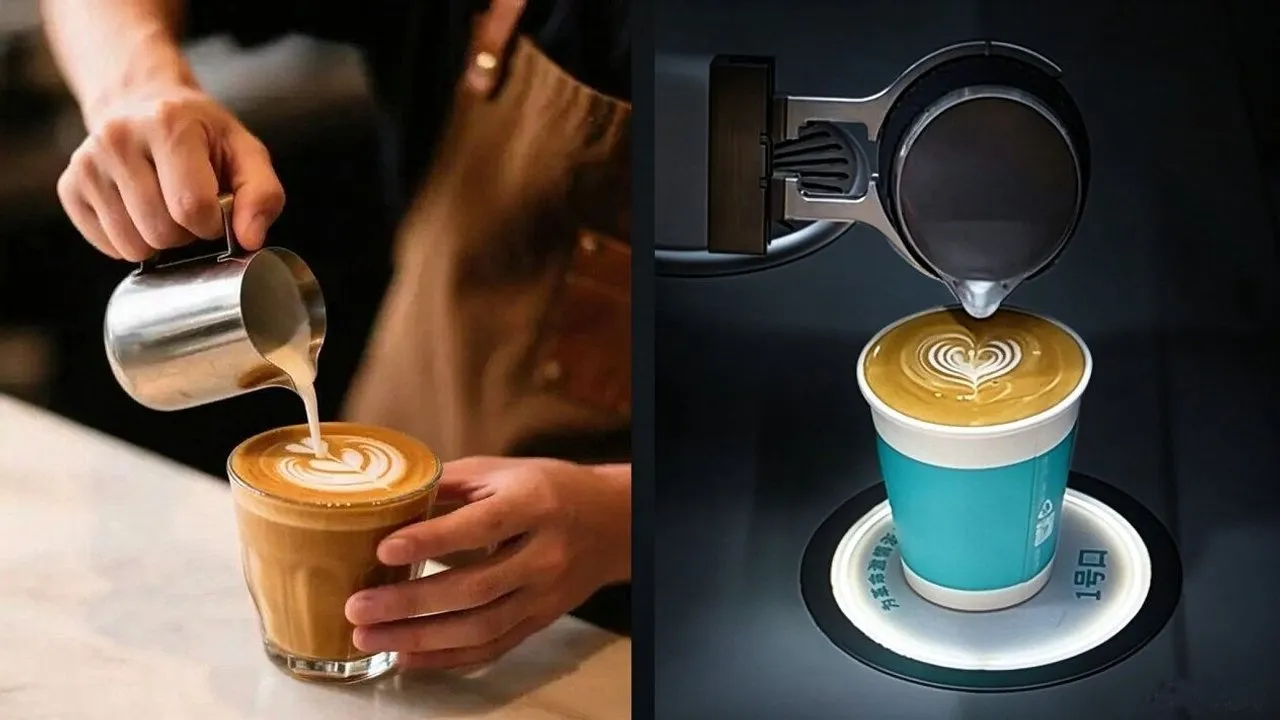
Shanghai Hi-Dolphin Robot Technology Co., Ltd.’s seventh-generation COFE+ robotic barista completed five drinks faster than an award-winning barista in a live competition at The 2026 China Yiwu Imported Commodities Fair. The November 14, 2026 challenge at the 7th LD International Coffee Masters Competition measured end-to-end serving time and beverage-weight consistency. COFE+ averaged 49.4 seconds per drink, compared with 57.2 seconds for the human competitor. It also recorded a sample standard deviation of 1.72 g across five lattes, compared with 7.61 g for the award-winning barista.
Speed Across Five Drinks
Timing began when an order was placed and ended when the finished drink was handed to judges. The test included order placement, cup collection, preparation, completion, and handover, with results recorded to the nearest second.
COFE+ made an espresso in 30 seconds, compared with 32 seconds; a cappuccino in 36 seconds, compared with 40 seconds; and a classic latte in 43 seconds, compared with 48 seconds. It completed swan-design latte art in 70 seconds, compared with 88 seconds, and an Audrey Hepburn portrait latte, produced using 3D printing, in 68 seconds, compared with 78 seconds.
Across the five drinks, the human barista took approximately 1.16 times as long as COFE+.
Consistency in Latte Preparation
Each competitor prepared five lattes of the same type for on-site weighing. COFE+ produced drinks weighing 232.5 g, 232.2 g, 233.3 g, 234.7 g, and 230.0 g, for an average weight of 232.54 g.
The award-winning barista’s five drinks weighed 233.7 g, 232.1 g, 230.2 g, 246.2 g, and 225.9 g, for an average weight of 233.62 g. The human barista’s sample standard deviation was approximately 4.43 times that of COFE+.
Robotic Coffee Store Model
COFE+ uses a Light-Store Business Model combining compact robotic cafés, automated beverage production, and centralized remote operations. The company says one operator can remotely manage five to ten robotic café units, depending on operating conditions and management requirements.
The system is designed for 24-hour operation, while replenishment, cleaning, and maintenance remain part of normal operations. According to company estimates, the model can reduce operating costs by up to 90% and electricity consumption by up to 80% compared with conventional café formats, with actual results depending on location, operating conditions, and comparison assumptions.
Commercial Capacity and Reach
The seventh-generation COFE+ platform includes a six-axis robotic arm, freshly ground coffee preparation, automated extraction, milk steaming, beverage assembly, and robotic latte art. It supports more than 300 beverages across eight major categories.
Its robotic coffee kiosk occupies approximately 2.35 square meters and is engineered for a rated service life of more than 10 years. The company lists a single-unit design capacity of up to 500,000 cups and maximum daily throughput of up to 1,000 beverages, subject to operating conditions and maintenance requirements.
Expanding Automated Beverage Service
According to the company’s September 2026 announcement, COFE+ solutions had reached 75 countries across five continents and more than 200 Chinese cities across 27 provincial-level regions. The company also reports serving more than 500 million cups worldwide.
For operators considering automated beverage service in airports, hospitals, universities, shopping centers, office buildings, and transportation hubs, the Yiwu results provide measured data on serving speed and repeatability alongside the company’s remote-management model.