HR Leaders Report Workforce Skills Visibility Gap
University of Phoenix Future of Skills Development report finds HR leaders see a gap between required skills and employee capability.
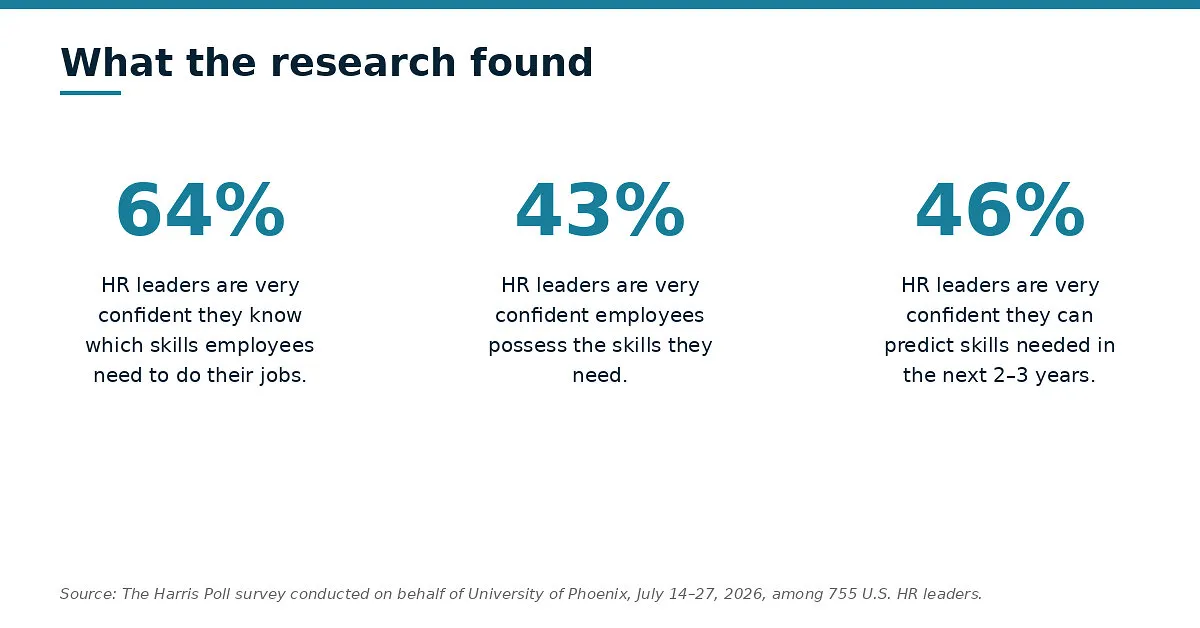
University of Phoenix has published new research finding that 64% of U.S. HR leaders are very confident they know the skills employees need, while only 43% are very confident employees have those skills. The Future of Skills Development report surveyed 755 HR leaders and examines workforce readiness as AI, automation and other technologies change roles and workflows. Just 46% of respondents were very confident they could predict needed skills two to three years ahead. The findings give employers a practical reason to review how they identify, assess and communicate skill needs.
AI Adds Planning Uncertainty
Keeping pace with AI and other emerging technologies was the most common source of uncertainty in planning future workforce skills, cited by 27% of respondents. Employers are balancing technical requirements with communication, collaboration and problem-solving: 59% named soft or durable skills as their primary talent development focus, compared with 37% for technical skills.
Nathan Jones, vice president of Product Management, Workforce Solutions Group at University of Phoenix, said:
“AI is accelerating how quickly work and skill requirements evolve, but this is not a choice between technical expertise and human capabilities. Organizations need a clearer view of the skills they have, the skills they need and where gaps are emerging. Employees need that visibility as well — clearer signals about what to develop next and credible ways to demonstrate what they can do. The opportunity is to make skills more visible, measurable and connected to the work that actually needs to get done.”
Nathan Jones, vice president of Product Management, Workforce Solutions Group at University of Phoenix, said:
“AI can change the tools people use and the tasks within a role, but technology does not eliminate the need for judgment, communication, problem-solving and adaptability. The workforce conversation needs to move beyond technical skills versus durable skills. Increasingly, people need both.”
Skills Evidence Remains Uneven
Managers’ direct knowledge and performance reviews were each used by 51% of respondents to assess employees’ existing or needed skills. Yet fewer than half, 49%, said managers were very prepared to identify, assess and discuss skill gaps and development needs with employees.
The same challenge extends to hiring. Durable skills were the candidate capability most often considered difficult to verify or assess, at 20%, followed by emerging or specialized skills such as AI and cloud computing at 18%. The largest share of HR leaders, 38%, said they only felt confident in an applicant’s capability after a skills evaluation, assessment or technical test.
Digital methods are becoming part of the hiring evidence employers use. More than seven in 10 HR leaders, 71%, said their departments use microcredentials, digital badges, digital wallets or other digital tools to verify skills for at least some applicants.
Actions for Employers and Workers
Only 44% of HR leaders said their organizations regularly conduct formal skills-gap analyses, and 51% said their organizations very clearly communicate the skills employees need for future roles. The research points to more consistent analysis, clearer communication, personalized development and credible assessment methods as areas employers can improve.
For employees, the report recommends regular discussions with managers about the skills becoming more important in their roles, the capabilities they already demonstrate and the projects, assessments or experiences that could provide evidence of further development.
Different Sectors Show Different Needs
Industry subsets in the survey showed differing workforce priorities. In manufacturing, 32% identified keeping pace with technological change as their greatest source of uncertainty, while 56% placed greater emphasis on technical skills than soft or durable skills.
In financial services, 64% identified durable skills as their primary development focus, and 35% were very confident employees possessed the skills needed for their jobs. Healthcare respondents showed higher confidence: 82% were very confident they knew needed skills, 70% were very confident employees possessed them and 71% said future skill expectations were communicated very clearly.
University of Phoenix notes that these industry results are directional because they represent subsets of the wider survey. Employers can review the Future of Skills Development report, including its research methodology and full findings.