Pearson Flags AI Capability Gap in Skilled Jobs
Pearson AI skills gap research finds a triple capability gap in skilled jobs as AI adoption outpaces education and training.
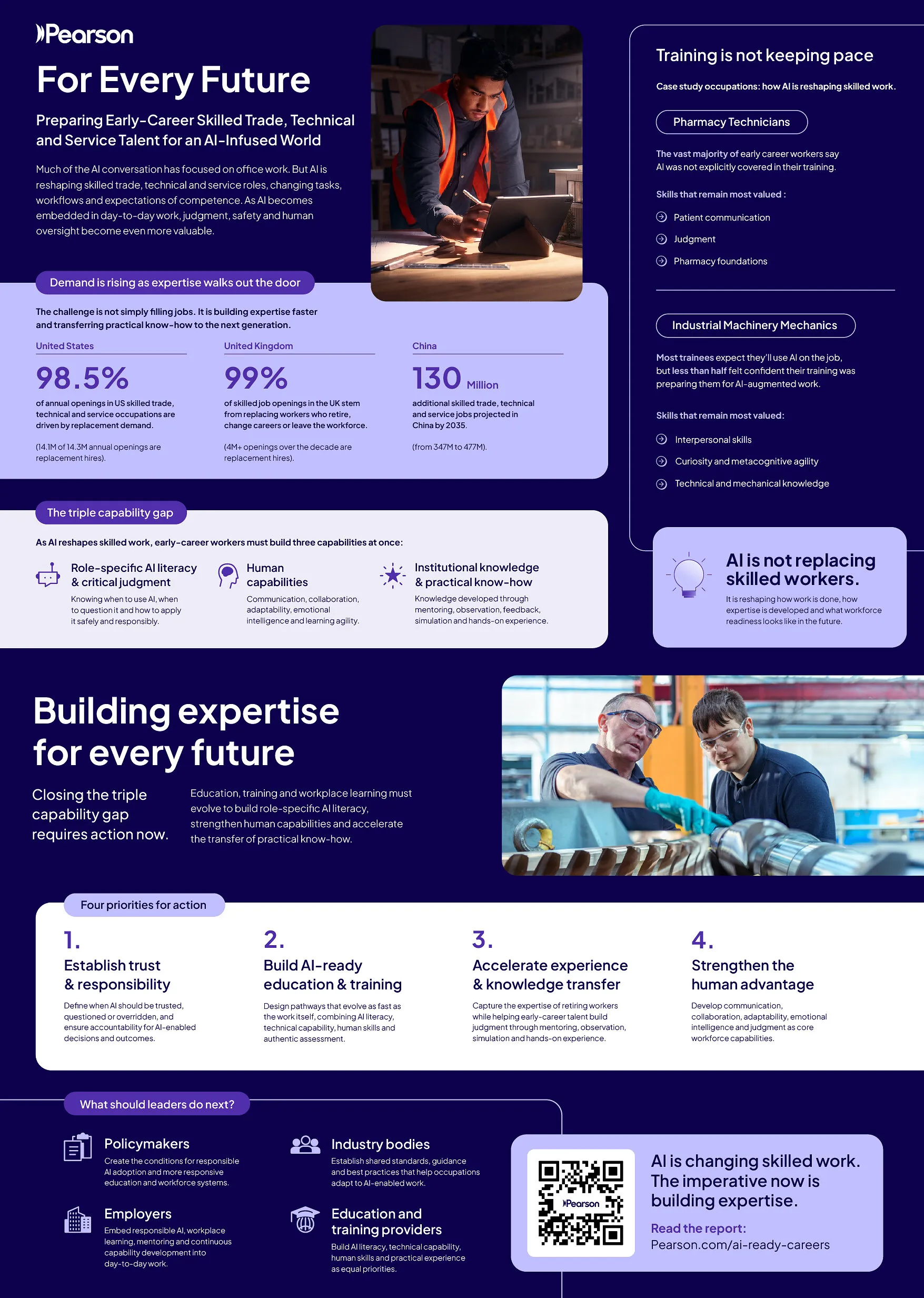
Pearson has released research warning that skilled trade, technical and service occupations face a “triple capability gap” as AI changes job requirements and experienced workers retire. Its report, launched at the WorldSkills International Conference 2026 in Shanghai, examines early-career talent in the US, UK and China. Pearson found that 99% of skilled job openings in the UK and 98.5% in the US stem from workers retiring, changing careers or leaving the workforce. The report says employers need workers who can apply AI safely, use human skills and build practical expertise.
Three Capabilities Needed
Pearson’s For Every Future: Preparing Early-Career Skilled Trade, Technical and Service Talent for an AI-Infused World identifies three capabilities workers need at the same time: role-specific AI literacy and critical judgment, human capabilities such as communication and collaboration, and institutional knowledge gained through practical experience.
The report focuses on roles that help operate hospitals, factories and infrastructure. It says AI is reshaping these jobs faster than education and training systems can adapt, while experienced workers are leaving with decades of practical knowledge.
Sharon Hague, President, English Language Learning & UK CEO, Pearson, said:
“We're entering a period where many of the workers who keep hospitals, factories and critical infrastructure running will need three things at once: the judgment to work safely with AI, the human skills technology can't replace, and the hands-on expertise traditionally learned from experienced colleagues. The challenge is that demand for these workers is rising just as many experts are retiring and taking decades of practical knowledge with them. If we don't rethink how expertise is developed, the gap between what employers need and what workers can do will continue to grow.”
Training Pace And Safety
The research identifies pharmacy technicians and industrial machinery mechanics as examples of occupations where accuracy, safety and human oversight remain central as AI becomes part of daily work. One UK pharmacy industry participant reported that revising pharmacy technician education and training standards takes two to three years. Fewer than half of industrial machinery mechanics feel their training prepares them for AI-enabled work.
Among surveyed pharmacy technicians, 98% rated exactness and accuracy as extremely important, while 44% rated the consequences of error as extremely serious. Pearson says education, training and workplace learning must build AI literacy and critical judgment, strengthen human capabilities, and provide mentoring, observation, feedback, simulation and hands-on experience.
Workplace Learning Focus
For employers in skilled occupations, the report sets out a clear workforce development issue: expertise is increasingly built through AI literacy, human capabilities and practical know-how together. The research says the cost of failing to address the gaps could include difficulty finding and developing skilled workers, with potential effects on safety-critical occupations and essential services.
Pearson’s research combines labor market and AI exposure analysis in the US, UK and China with surveys, interviews and roundtables involving employers, educators, industry bodies, workforce experts, students and early-career workers. It also includes in-depth analysis of pharmacy technician and industrial machinery mechanic roles.