Florida Banks Face Quantum Readiness Gap
Florida bank quantum readiness results show 27 of 81 institutions need steps to protect connections against future decryption.
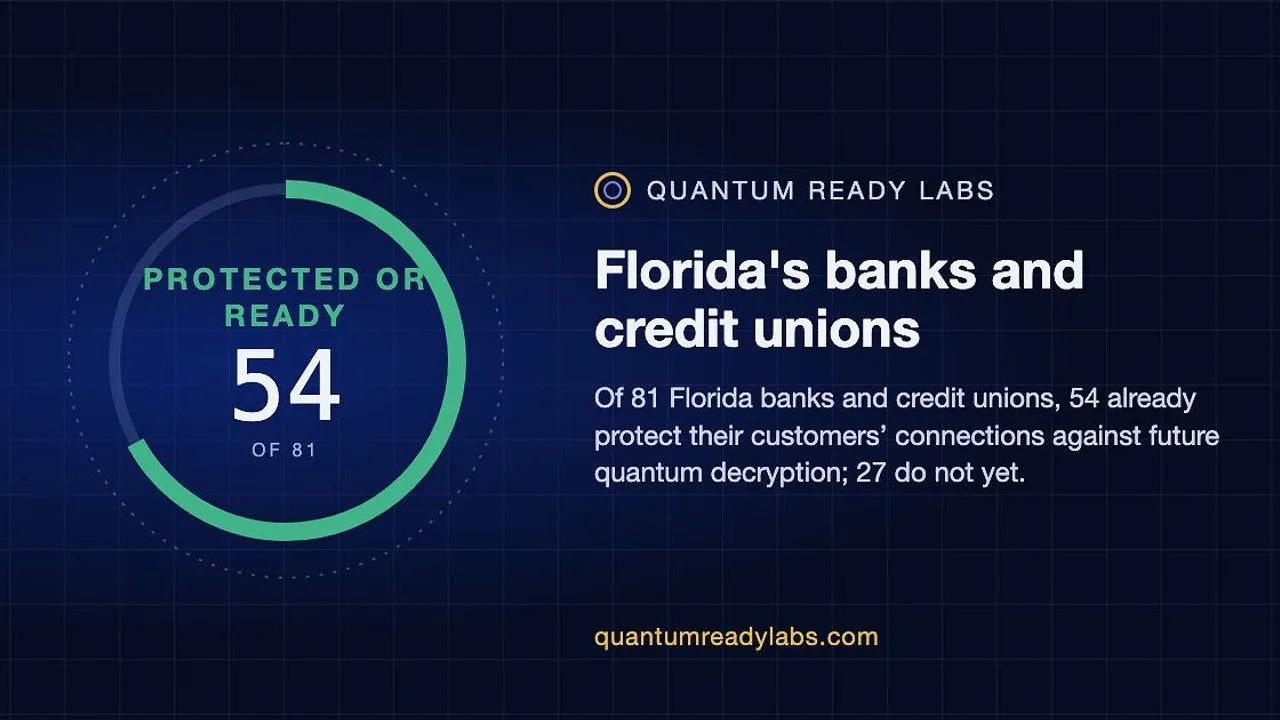
Manteiga Foundation has published a readiness scan finding that 54 of 81 Florida-headquartered banks and credit unions protect customer connections against future quantum decryption, while 27 do not yet. Its Quantum Ready Labs study lists every institution tested and its result. The assessment found 10 institutions were Exposed and 17 were At risk, while 30 were Protected and 24 were Ready. The median quantum-readiness score was 85 out of 100.
A Timed Security Risk
The release states that nothing is broken today and that no account, login, or transaction is at risk from the issue described. Its concern is that encrypted traffic recorded now could be decrypted in the future by a sufficiently large quantum computer.
The note says the estimated machine size needed to break current key exchange fell from about 20 million qubits to under 1 million in 2025. The National Institute of Standards and Technology has set 2030 as the start of retirement for current key exchange and 2035 as its end, according to the release.
Jaime Manteiga, Co-Founder at Manteiga Foundation, said:
“Nothing is broken today, and that is exactly why this is the moment to act. Confidentiality is the urgent part of the quantum transition, the fix is small, and most of these institutions are one setting away. We built the scanner so that anyone can see where a host stands in a second and what to do next.”
Steps for Financial Institutions
For the 10 Exposed institutions, the recommended next step is enabling TLS 1.3, a protocol generation that can support post-quantum protection. The 17 At risk institutions already use a modern protocol but have not switched on post-quantum key exchange.
For those organizations, the stated action is to enable X25519MLKEM768 through a configuration line or server setting. The study reports that browsers already protect traffic using the newer approach.
Open Source Testing Tool
Quantum Ready Labs is free and open source under the MIT license. Users can enter a host name to receive a readiness stage, score, recommended next step, and cited standards, with results available by link or as a five-page PDF.
Each institution’s public primary domain was tested on October 18, 2026, using 14 TLS handshakes and one ordinary connection. No pages were opened and no logins were attempted. The foundation plans quarterly rescans, and institutions can run a current test at any time.
Organizations seeking assistance can use N30.ai, Manteiga Foundation’s cybersecurity consulting practice for post-quantum transition work.